Role: Lead designer (1 of 4) |
Responsibilities: |
Collaborators: 10+ teams, product, data science, conversation teams, accessibility, legal, and engineering. |
Timelines: Q1, 2026 |
Overview
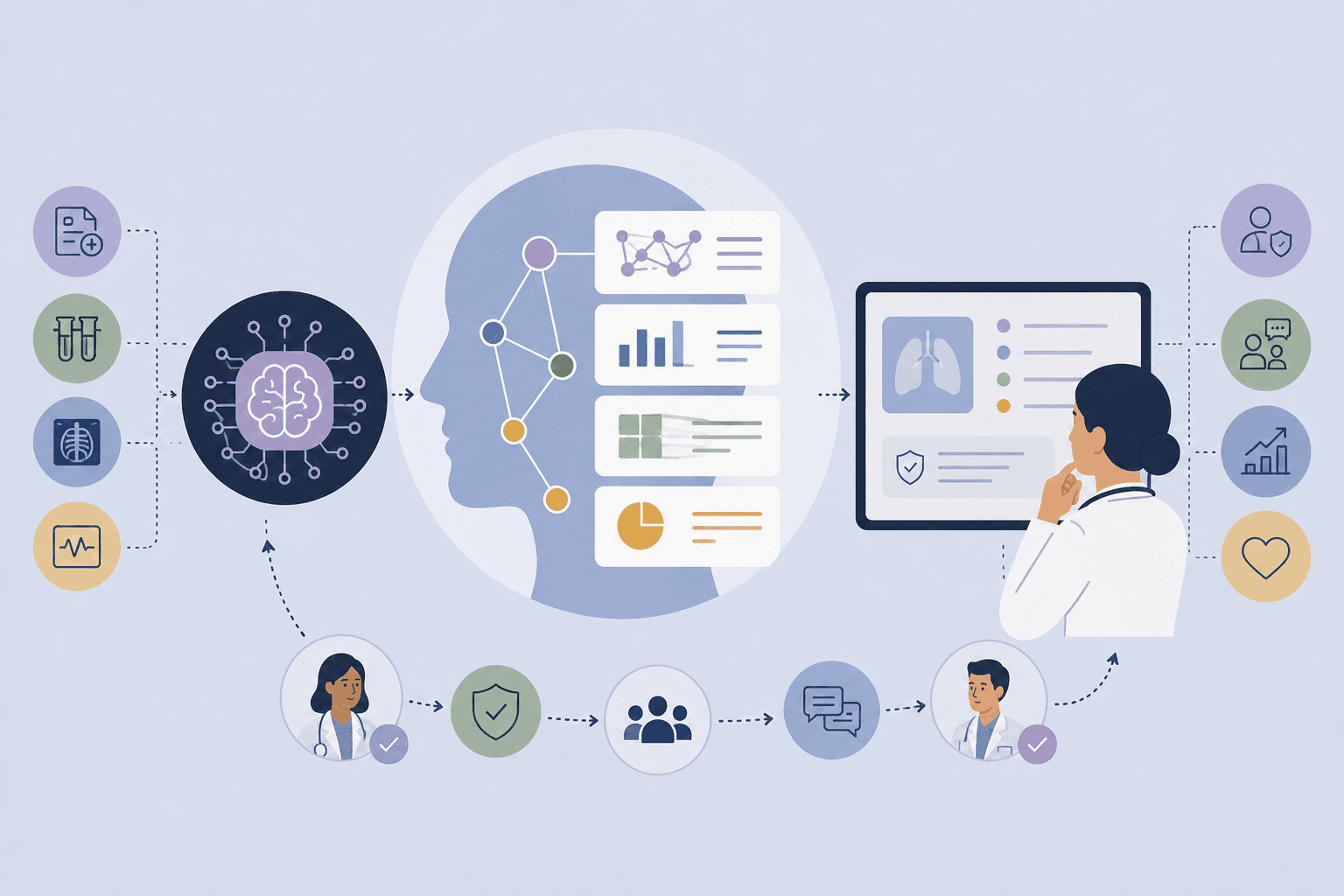
I led the design of AI transparency patterns for Oracle Health's clinical AI platform, partnering with product, engineering, data science, and clinical teams. The core challenge was trust: clinicians new to AI had no mental model for how responses were determined or why the system behaved as it did. I defined how, when, and where to surface AI thinking states, progress, and reasoning to make the system feel legible and trustworthy without adding noise to complex clinical workflows.
Goals
Help clinicians understand what the AI is doing and why, reducing uncertainty and building confidence in AI responses.
Surface the right signals at the right moment, calibrated to context, surface, and cognitive load.
Establish a scalable transparency pattern library applicable across both core clinical platforms.
Problem
Clinicians didn't trust what they couldn't see.
Oracle Health's clinical AI platform was built to help clinicians work faster and smarter. But for most users, it was a first encounter with AI — and the system gave them nothing to hold onto.
The black box problem
The AI would respond, but offered no signal of what it was doing, how it reached its answer, or how confident it was. For clinicians encountering AI for the first time, this opacity felt unsettling. They couldn't evaluate the response. They couldn't calibrate their trust. And in a high-stakes clinical environment, an AI you can't read is an AI you won't rely on.
Core tension:
If I don't understand how the AI got there, how do I know when to trust it?
Why it mattered
Low trust means low adoption. And low adoption of a platform serving 23.4% of U.S. acute-care hospitals isn't just a UX problem. It's a product and business risk. The design challenge was clear: make the AI legible, without making the experience noisier.
Research
I ran usability studies, conducted clinician interviews, and reviewed existing transparency and AI communication patterns. The most important finding reframed the entire project.
Key insights
Insight #1
Clinicians didn't want more information. They wanted the right information at the right moment. Overwhelming them mid-workflow reduced, not built, trust.
Insight #2
Trust wasn't about volume of explanation. It was about relevance. A signal that arrived at the wrong moment felt like noise, even if the content was accurate.
Insight #3
Backend processing, things happening under the hood with no bearing on the clinician's next action, added confusion when surfaced. Users didn't need to see it.
Insight #4
Different moments in a workflow carry different stakes. A diagnostic suggestion needs more explanation than a scheduling confirmation. Context determines visibility.
The reframe
The design question shifted from "how do we make AI visible?" to "how do we surface just enough, at exactly the right moment?" That distinction drove every decision that followed.
Ideation
I explored several directions — from verbose real-time status updates to minimal single-state indicators. Each revealed something different about where transparency helps and where it hurts.
What didn't work
Surfacing all AI activity created the opposite of trust. Backend processing transitions — system states that had no bearing on what the clinician needed to do next — added visual noise and made the system feel more complex than it was. Showing everything felt honest in theory, but overwhelming in practice.
The principle that emerged
Not all AI activity is equal, and not all of it deserves visibility. The solution wasn't about how much to show, it was about earning the right to show something at all. Each state needed to justify its presence in the experience.
Design
The final system organized AI activity into three tiers of visibility, each calibrated to how much a clinician needed to know at that moment to act confidently.
[pic]———
Designed to scale
The framework wasn't built for a single feature. It was designed as a pattern library, a shared system that product and engineering could apply consistently across both core clinical platforms and future AI-powered experiences, without making one-off visibility decisions per feature.
Design principles behind the system
Context over consistency
The same AI state surfaces differently depending on where the clinician is in their workflow and what decision they're facing.
Earned visibility
Every transparency signal had to justify its presence. If it didn't help the clinician act, it didn't belong in the experience.
Trust through relevance
Trust isn't built by explaining everything — it's built by explaining the right things at the right moments.
Silence as a design decision
Choosing not to show something is as deliberate as choosing to show it. Restraint is part of the design system.
Impact
The project was handed off to engineering in Q1 2026, with a complete transparency pattern library and design specifications covering both core clinical platforms.
Why the approach resonated
The tiered model worked because it respected how clinicians actually work, under cognitive load, mid-task, with little tolerance for interruption. Rather than designing for transparency as an abstract value, the framework was grounded in specific workflow moments. That specificity is what made it feel right to the people using it.
Reflection
What this project taught me
The biggest shift was letting go of the instinct to show everything. In AI design, transparency can feel like a virtue, the more you reveal, the more honest the system seems. But clinicians taught me that trust is built through relevance, not volume. Showing the wrong thing at the wrong moment is just as damaging as showing nothing at all.
What I'd do differently
I'd map trust breakdown moments earlier and more precisely. The design decisions that mattered most were the ones that addressed specific moments where trust collapsed — not the system as a whole. Starting there, rather than arriving there through iteration, would have sharpened the framework faster and with more clinical grounding from the start.